
Searching Webster Parish Criminal Dockets
For a 26th Judicial District Court case, the online door is Webster ClerkNet. The Webster Parish Clerk of Court links it as its search path. Its public landing screen takes a case number, instrument number, or name. Results filter in real time. You need a registered account for actual use. Minden or Springhill city cases, justice-of-the-peace matters, and federal proceedings may not appear in this district-court index at all, so match the court first.
Search with your strongest identifier. A complete docket number beats a common name every time. Before calling a result a match, compare the parish, the court, and the case category. ClerkNet is a route in, not the final word. Its own terms warn that indices can contain errors, images may be protected, and availability is not guaranteed. When something conflicts, the courthouse index and the Clerk's certified record control.
- Open ClerkNet from the official Clerk link and enter the case number, instrument number, or name.
- Register or log in when the application requires an account before search results can be used.
- Check that the returned entry identifies Webster Parish and the 26th Judicial District Court.
- Read the current setting, status, and available entry history without assuming a status states the final outcome.
- Contact the Criminal Department for an official copy, certification, or minutes extract when the index is incomplete.
Note: A city-court ticket or a federal case needs the office that court names, not a district-court name search.
Webster Criminal Search Limits
The Webster Clerk criminal records page is the place to start for a local criminal docket search. The Clerk will search ten years of 26th JDC Webster Parish records for $20 per name. That fee buys a local search only. It is not a statewide check. It is not a city-court lookup, a federal-court search, or a law-enforcement criminal-history certification either. Copies run $1 per page if you want the paperwork itself. Certification costs $5, and an extract of court minutes is $10. Call ahead before sending any payment. Confirm the current charge and the exact product you need.
The Clerk's criminal page spells out the full search and copy route. That includes what the court records search covers and what it does not.
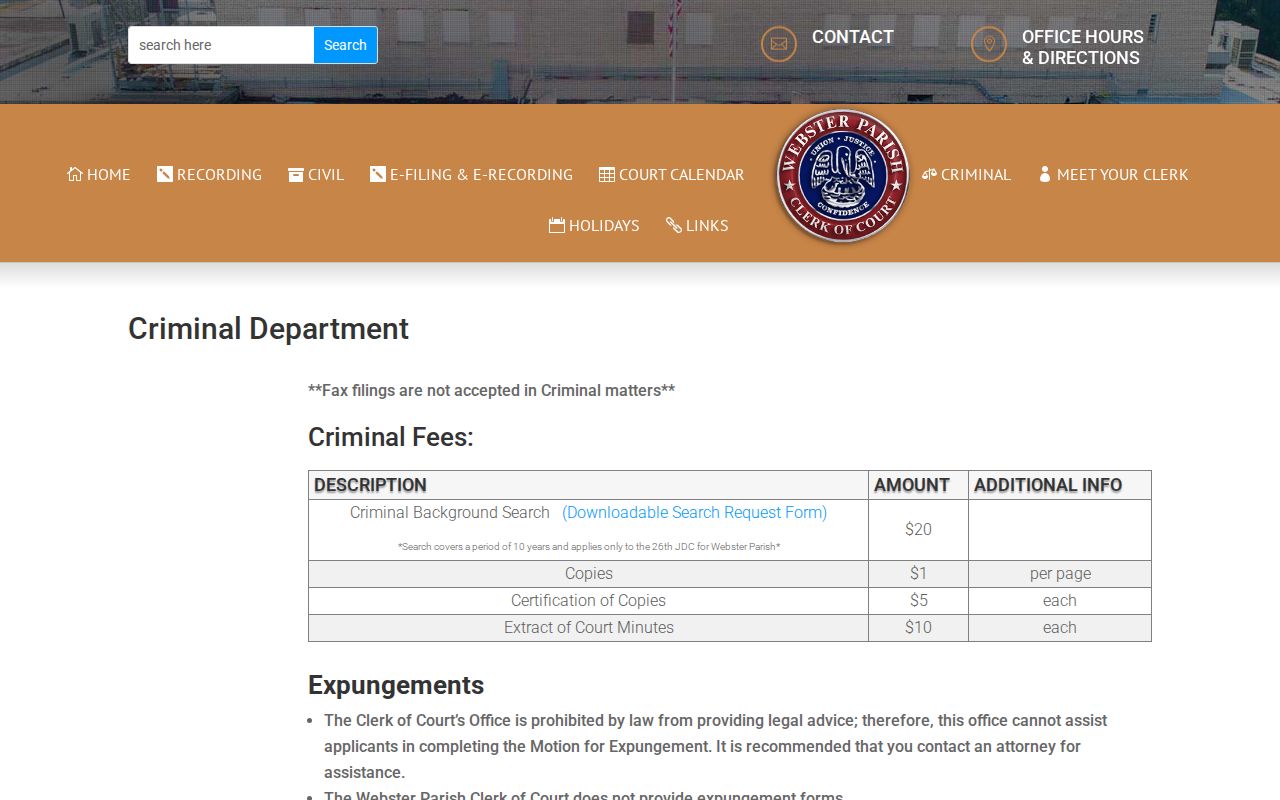
Requests can be mailed or hand-delivered with payment. They can also be routed through the published Criminal Department channel under its stated payment process. If optional identifiers are needed to separate one record from another, send them only through the Clerk's request channel. The form allows return by mail, email, or a pickup call, though it promises no processing time. Keep sensitive details out of any public search or correspondence that does not require them.
Inside a Webster Parish Criminal Docket
The District Attorney's docket PDFs give the clearest public view of a Webster criminal layout. A representative PDF heads the page with the Webster Parish District Court Docket, the date, the judge, and the courtroom, then lists fields for defendant, docket number, courtroom, status, police agency, charge, DA, criminal lawyer, judge, and notes. ClerkNet's public landing page shows no complete case-detail screen, so a broader public field set cannot be promised here.
| Heading | Identifies the docket date, assigned judge, and courtroom for that session. |
|---|---|
| Docket No. | The PDF's Docket No. field identifies the case; criminal examples use numeric identifiers and can include count suffixes. |
| Status | Shows the procedural setting, such as arraignment, status hearing, trial, or bond return. |
| Charge | States the charge listed for the session. A charge is not proof of guilt. |
| Police | May show the police agency or an abbreviation, including LSP, WPSD, MPD, or SPRING. |
| Notes | Can record a future date or an event reference such as diversion review or fine-and-cost review. |
A docket is a running event record, not a story of the evidence. Read each entry as a procedural snapshot. When you need a precise order, plea, judgment, or underlying filing, ask the Webster Parish Clerk of Court for the official record instead of inferring it from a short PDF line.
Webster Criminal Docket PDFs
The 26th Judicial District Attorney's Webster docket archive posts its criminal docket schedules as PDFs. You can pull regular, traffic, 30-day PJ, and final petit-jury settings from there. Think of it as a date-and-category archive rather than a name or case-number query database. You pick a published date, a judge, and a courtroom. That shows whether a criminal session is listed. When you need the official file, the Clerk handles the record request.
The DA's published archive gives a hearing-day view of Webster Parish criminal docket activity, date by date.
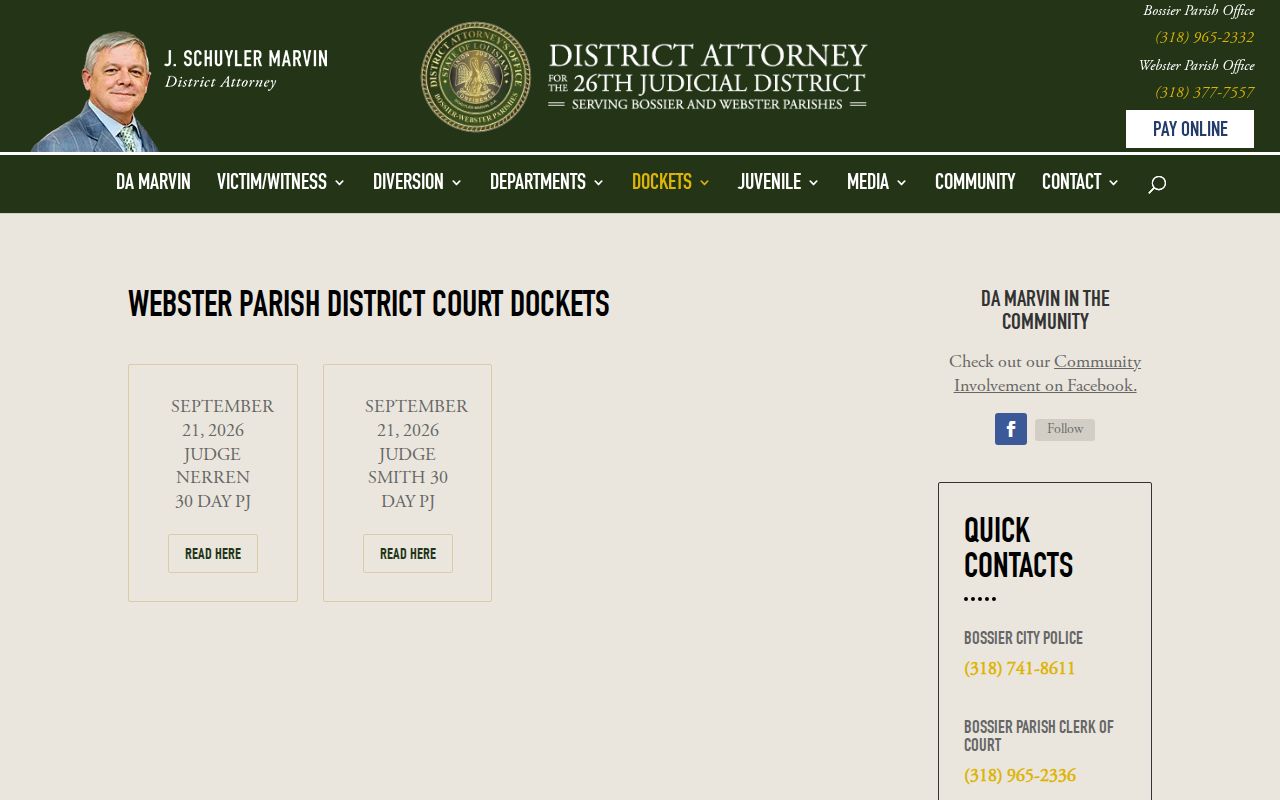
These PDFs help trace an upcoming or recent setting. They can also reveal a later date or a status label. Describe any PDF entry neutrally: it reports what was set or recorded for that session. It says nothing about events outside the docket. It also says nothing about the legal merits of a pending case.
Note: The archive complements the Clerk's index and records service; it replaces neither one.
How a Criminal Case Moves
Criminal docket events often run from filing to arraignment, through later settings, toward a disposition or sentencing event. That order shifts when a case is continued, when bond status comes up, or when the court sets a review. Expect labels in the DA PDFs like Arraignment, Arraignment Bond Return Date, For Further Disposition, Status Hearing, Rule to Show Cause, Trial, Probation Violation Hearing, Fine & Cost Review Hearing, Diversion Review Hearing, Summons/ARR, and Bond Return.
- Arraignment
- A proceeding where a defendant is informed of the charge and enters, or is scheduled to enter, a plea.
- Bond return
- A setting addressing bond status or a return date.
- Status hearing
- A hearing used to report progress or select the next procedural step.
- Diversion review
- A review of a participant's progress or status in a diversion program.
Docket flow: Filing › Arraignment › Pretrial setting › Plea or trial › Disposition › Sentencing. A continuance or reset moves a scheduled event; it is not by itself a dismissal. The newest confirmed setting matters most.
Webster Criminal Division Assignment
The 26th JDC has six elected judicial divisions, A through F. Local rules put felony and misdemeanor criminal cases through random allotment among those divisions when a bill of information is filed or at the 72-hour hearing. Traffic and wildlife matters follow a different path. A division is a judge's assigned district-court section, while a courtroom is the room or calendar column shown for a particular setting. Related terms, but not interchangeable ones.
Division clue: A division or judge shown on a docket can help locate the correct session, but formal records requests still go to the Webster Parish Clerk of Court.
Check the Clerk's live calendar for a given day. Weigh it against the DA's published PDF archive. The calendar tells you which courtroom a Webster Parish case sits in. It also flags no-court dates. The case record itself is what shows the true procedural history. One caution: a calendar date never promises when a case will actually be reached.
Courts That Hold Criminal Dockets
Search where the case actually lives. The court named on the ticket, summons, docket, or filing header points you to the right records. For Webster Parish district criminal matters, that court is the 26th Judicial District Court. It is the parish's principal state trial court. The Clerk holds its Webster records. City courts, other lower local courts, and the federal court system each keep their own files. So confirm the court before anything else. That matters most when all you have is a street address or the name of the issuing agency.
| Custodian | Criminal docket scope | Best first route |
|---|---|---|
| 26th JDC / Webster Clerk | District felony and misdemeanor matters in Webster Parish | ClerkNet, Clerk request, or DA docket PDF |
| Minden or Springhill City Court | Separate city criminal and traffic matters | Confirm directly with the city court |
| Western District of Louisiana | Federal criminal matters involving Webster Parish | PACER and CM/ECF, not ClerkNet |
| Justice of the peace or mayor's court | Its own limited local docket | Confirm with the issuing court |
A federal case can name a Webster party and still never touch the 26th JDC. City tickets work the same way. Many never show up in the parish district index at all. When picking where to look, trust the court caption and case number. Those beat a party name every time.
Webster Criminal Minute Entries
Louisiana R.S. 13:5992 directs district clerks, through LCRAA, to give the public electronic access to minute entries or summaries. The cases must be qualifying criminal ones. They had to be filed on or after January 1, 2020. Statutory limits still apply. A minute entry answers a procedural question. It says what happened in court. But the law does not put every pleading, exhibit, photograph, or record image online. Traffic cases fall outside the required electronic criminal-minute-entry category entirely.
Does the index line or PDF leave the record question open? Ask the Criminal Department for the right product. Options include a plain copy, a certified copy, or a minutes extract. Written requests work best. Add an approximate date range. State the record type you want and whether you need certification. Staff can locate and copy records, though the Clerk does not give legal advice.
Webster Parish Clerk of Court
410 Main Street, Minden, LA 71055
P.O. Box 370, Minden, LA 71055
318-371-0366
Sealed Dockets and Public Access
Louisiana opens its court records broadly, yet the rule has edges. Some files are sealed, expunged, confidential, or only partly restricted. Juvenile material carries the strongest protection of all. That is why an online docket search may omit a case. It may display a restricted marker. Or it may show fewer entries than an authorized person could view in the full file. A blank result has other explanations too. The matter may predate the local search window, lack digitization, belong to a city court, or sit in federal court.
Key rules:
Louisiana R.S. 44:1 broadly defines public records, subject to legal exceptions.
Code of Civil Procedure art. 251 identifies the clerk as custodian and generally permits inspection and copies during office hours.
Children's Code art. 412 makes juvenile records confidential except for limited authorized access.
Ask at the counter before you bring any equipment. Inspection and copying methods are limited. Under Article 251, private copying or scanning devices are restricted unless the court orders otherwise. Request the public portion of a specific record. Do not ask for sensitive personal details pulled from a restricted file. Note: Public access does not authorize copying or republishing protected identifiers from a criminal filing.
Webster Criminal Privacy Boundaries
Code of Criminal Procedure art. 971 governs expungement. It makes the process remove qualifying arrest or conviction information from public view. The records stay confidential but available to the criminal-justice agencies the statute names. The Clerk's criminal page points anyone seeking expungement to the formal process. It cannot give legal advice or pick a form for you. Each separate arrest date needs its own motion. It also needs its own nonrefundable payment to every listed agency.
Louisiana's 2026 filing and privacy changes add another layer. Full sensitive identifiers are now restricted in filings. Keep the records work on the docket. Stick to the requested court document and the official access process. Report any procedural status or charge as the docket presents it. A pending case is never a conclusion about a person.